
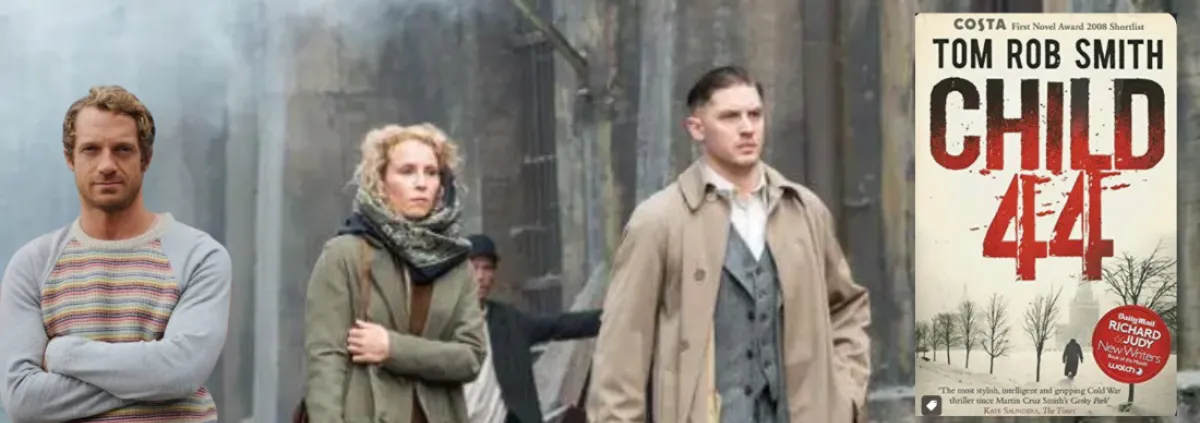
Tom Rob Smith was 27 when Child 44 was published. It won the Crime Writers' Association Ian Fleming Steel Dagger, was longlisted for the Man Booker Prize, and launched a trilogy that confirmed him as one of the most significant thriller writers of his generation.
The Story
Moscow, 1953. Leo Demidov is an MGB officer — the secret police — true believer, decorated war hero, loyal servant of the state. When the body of a child is found near railway tracks, Leo is ordered to close the case. The boy's death was an accident. There is no investigation. But the bodies keep appearing, always near railway lines, always children, always bearing the same marks.
When Leo's own wife falls under suspicion of disloyalty, his world collapses. Stripped of rank and exiled to the provinces, he begins — against every institutional pressure, against the literal impossibility of what he is doing — to investigate. To admit the murders exist is to admit that the state has lied. To investigate is to become an enemy of that state. The thriller machinery is relentless, but what drives the novel is something more profound: a man dismantling his own belief system piece by piece, in real time, under lethal pressure.
The Real History Behind the Fiction
Child 44 is loosely inspired by the case of Andrei Chikatilo, a Soviet serial killer who murdered at least 52 people between 1978 and 1990, and whose crimes were suppressed, mishandled, and denied by Soviet authorities for over a decade partly because of the ideological impossibility of acknowledging them.
Smith took this historical reality and transposed it to the Stalin era, sharpening its implications. The result is a thriller in which the conspiracy is not a shadowy organisation but an entire way of thinking about the world.
Smith conducted extensive research into Stalinist Soviet life — the paranoia, the informer culture, the arbitrary terror of denunciation, the physical geography of Moscow and the Ural provinces. The period detail is worn lightly but it is everywhere, giving the novel an authenticity that purely invented dystopias struggle to match.
The Trilogy and Beyond
The story doesn't end there.
- Child 44 was followed by The Secret Speech (2010) and Agent 6 (2011), completing the Leo Demidov trilogy and tracking his story across three decades of Soviet history.
- A film adaptation was released in 2015, directed by Daniel Espinosa and starring Tom Hardy as Leo and Gary Oldman as his commanding officer.
- Smith went on to write The Farm (2014), a very different kind of thriller — quieter, more psychological, set between Sweden and England — which demonstrated that his range extended well beyond the Soviet world he had mapped so vividly.
Why Readers Keep Coming Back
Child 44 works as a thriller on the most immediate level: it is tense, propulsive, and difficult to put down. But it also works as a novel about ideology and self-deception — about what happens to ordinary human conscience when it is required to maintain a fiction that everyone knows to be false. Leo Demidov is not a hero at the start of this book. He is a functionary. Watching him become something better, at enormous personal cost, is the moral engine that drives everything else.
Published when its author was 27. Winner of the genre's most prestigious award. Inspired by a real history that the Soviet state spent years denying. Child 44 is a thriller that earns a place in our Author Spotlight.
Incredibly authentic. Tom Rob Smith has the setting nailed.
I agree, the setting was haunting.