
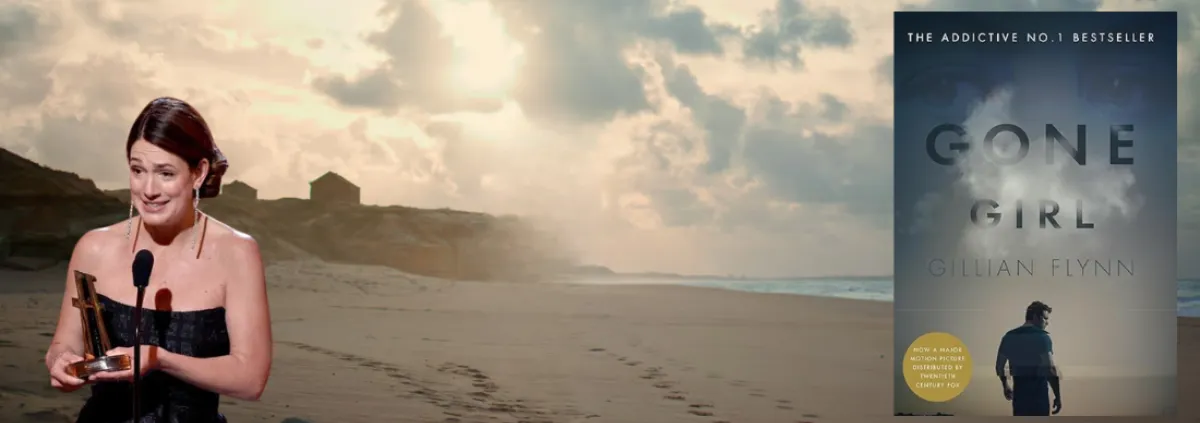
On the morning of their fifth wedding anniversary, Nick Dunne's wife disappears. The police are suspicious. The media descend.
And the reader, turning pages at an increasingly uncomfortable speed, begins to realise that almost nothing they have been told can be trusted. Gone Girl, published in 2012, did not merely become a bestseller. It rewired the psychological thriller genre and introduced a generation of readers to a particular kind of female character that fiction had largely refused to write: brilliant, furious, and absolutely not interested in being likeable.
Gillian Flynn: The Writer Who Made Marriage Terrifying
Gillian Flynn spent years writing about television before she wrote novels. As a critic for Entertainment Weekly, she watched thousands of hours of story, absorbing the mechanics of tension, pacing, and the narrative hook.
When she turned to fiction, she brought all of that craft with her — and added something to the screen could not easily replicate: access to minds that lie to themselves as fluently as they lie to everyone else.
The Story
Gone Girl is structured as two competing narratives. Nick tells his story in the present tense — the morning of the anniversary, the discovery of the disappearance, the investigation that begins to close around him.
Amy tells hers through diary entries, charting the arc of their relationship from dazzling New York beginning to something much darker. The novel's central formal device is the unreliable narrator pushed to its logical extreme: not one narrator you cannot quite trust, but two, each constructing a version of events that cannot be reconciled with the other.
Flynn is interested in the performance of marriage — in the roles that couples construct for each other and for the world, and the violence that can accumulate beneath a surface of apparent normality.
The novel's most famous passage, the Cool Girl monologue, became a cultural touchstone almost immediately on publication: a precise and scalding account of the self-erasure that women perform in order to be desired, and the rage that self-erasure eventually produces.
The Making of the Book
Flynn has spoken about deliberately writing female characters who are not sympathetic in conventional ways. Her debut novel Sharp Objects (2006) and its follow-up Dark Places (2009) had already established that she was not interested in the kind of female victim or female detective that crime fiction had made familiar.
Gone Girl took that instinct further, creating in Amy Dunne one of contemporary fiction's most discussed and debated characters — a woman whose actions are monstrous and whose intelligence is ferocious, and who refuses to be explained away by trauma or madness.
Flynn wrote Gone Girl while her husband was unemployed and she had recently been made redundant from Entertainment Weekly during an industry downturn. The novel's preoccupation with economic anxiety, with the collapse of a certain idea of American middle-class life, and with couples trapped in circumstances neither expected, reflects that moment with uncomfortable precision.
Adaptation and Aftermath
David Fincher directed the film adaptation in 2014, with Ben Affleck as Nick and Rosamund Pike as Amy. Pike's performance earned her an Academy Award nomination and introduced Amy Dunne to an even wider audience. Flynn wrote the screenplay herself, making significant changes to the ending that sparked considerable debate among readers of the novel.
Gone Girl's success transformed the commercial landscape for psychological thrillers, particularly those written by women and centred on female experience. The wave of domestic suspense novels that followed — the unreliable wives, the dark suburban marriages, the narrators who know less than they think — owe a significant debt to Flynn's willingness to go where the genre had previously hesitated.
Why Readers Keep Coming Back
Gone Girl is compulsively readable in the most literal sense: readers report finishing it in single sittings, turning back to re-read sections once the ending has re-contextualised everything that came before. But it is more than a mechanism. It is a novel genuinely angry about the expectations placed on women in relationships and in fiction, and that anger gives it an energy that pure plotting cannot sustain alone.