
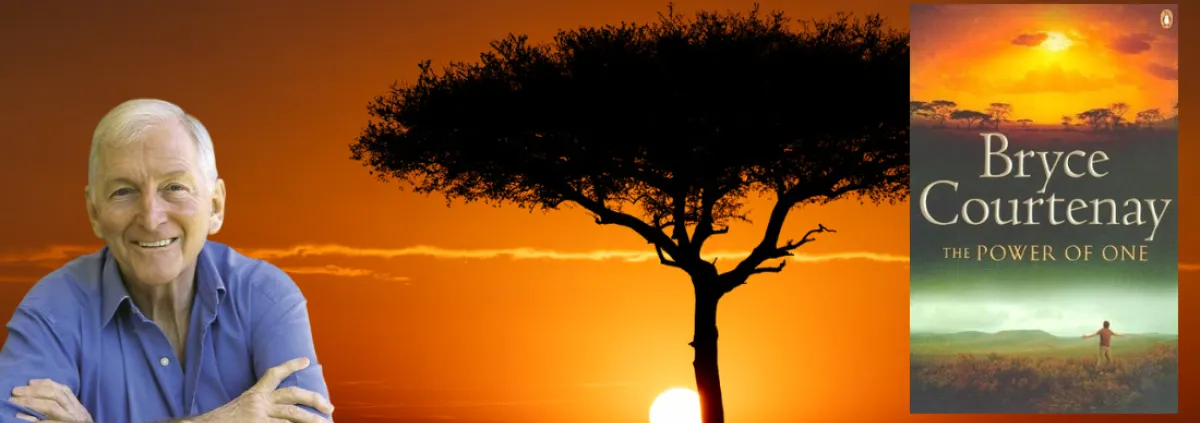
Most writers are told to start young, yet Bryce Courtenay published his first novel, The Power of One, at 55.
It sold millions of copies, was translated into dozens of languages, launched one of the most beloved franchises in Australian fiction, and introduced readers to one of the twentieth century's great literary heroes.
The Power of One arrived in 1989 as if it had been waiting inside him for decades. It had.
Courtenay was born in South Africa in 1933 and spent much of his working life in Australia as an advertising executive — one of the most successful in the country. He understood story, persuasion, and the rhythms of language. But fiction waited.
When he finally sat down to write The Power of One, he drew on a childhood that had marked him deeply: the violence, the beauty, the moral complexity of a country in the grip of racial ideology, and the people who shaped him within it.
The Story
Set in South Africa during the 1930s and 1940s, The Power of One follows Peekay, a young English-speaking boy growing up in an Afrikaner world that regards him with contempt.
Sent to boarding school at five years old, he encounters bullying of a kind that would break most children. Instead, it forges him. Under the unlikely mentorship of a German pianist named Doc and an Afrikaner boxing trainer named Geel Piet, Peekay begins to find his identity — and a dream of becoming welterweight champion of the world.
The novel spans roughly a decade of Peekay's life, moving from the humiliations of early childhood through adolescence and into young adulthood, against the backdrop of a society heading inexorably toward the formalised apartheid that would be enacted in 1948.
Courtenay never lets the political overwhelm the personal. This is a story about a boy becoming a man, about mentorship and loyalty and the inner resources that allow some people to survive what would destroy others.
The Making of the Book
Courtenay has spoken of The Power of One as deeply autobiographical in spirit, if not in every detail. The landscapes, the social textures, the particular cruelties of the boarding school system, the boxing gyms — these came from lived experience. He had carried the material for years before he found the form to hold it.
Writing in his fifties gave him something a younger author might not have had: perspective. The anger is present in the novel, but it is controlled anger, shaped into narrative rather than poured raw onto the page. The result is a book that moves between tenderness and fury with the ease of someone who has had long enough to understand both.
Legacy
The Power of One was adapted for film in 1992, directed by John G. Avildsen with Morgan Freeman in a pivotal role. Courtenay followed it with a sequel, Tandia, continuing Peekay's story.
He went on to write more than twenty novels before his death in 2012, all published in the last quarter of his life — a remarkable late flowering that challenged every assumption about when a writer's best work arrives.
The novel remains a set text in schools across Australia and South Africa. Its central argument — that one person, with enough conviction and enough support, can resist the worst that history throws at them — has lost none of its force.
Why Readers Keep Coming Back
The Power of One is one of those novels that readers tend to encounter at a formative moment and carry with them ever after. Its hero is genuinely heroic without being implausible. Its world is rendered with sensory richness. And its insistence that character matters more than circumstance is the idea that, once absorbed, is difficult to let go of.
Fifty-five years old. First novel. Millions of readers. The power of one, indeed.
I haven't read this book, but after seeing this, it's now on my TBR!
Sounds like one to be on my TBR