
Why history matters
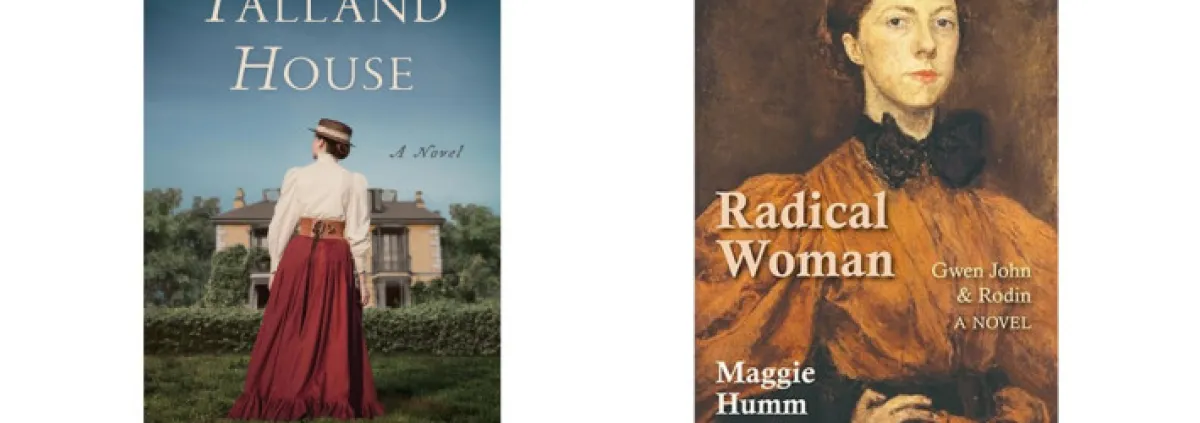
As Virginia Woolf said (so often misquoted!) ‘I would venture to guess that Anon, who wrote so many poems without signing them, was a woman’. Since women’s experiences are often underrepresented in mainstream history, fictions from a woman’s or gender-fluid point of view, like Virginia Woolf’s Orlando, can give us an immediate sense of women’s historical experiences. My favourite writing (and my own) is about historical women, my novels Talland House and Radical Woman: Gwen John and Rodin are both stories for our present time, exploring the tensions women experience between their public careers and private loves, and stories of specific moments in our past―a time when women first began to be truly independent.
Talland House
Set between 1900 and 1919 in picturesque Cornwall and war-blasted London, Talland House takes the artist Lily Briscoe from the pages of Virginia Woolf’s To the Lighthouse and tells her story, as a prequel and in the interstices of Woolf’s novel. It won an Women’s Fiction International Impact Award.
Lily lives through one of the most momentous periods in UK history, falling in love with her artist tutor, becoming an independent woman artist, a suffragette, and a nurse in WWI. Mourning her dead mother, Lily loves her surrogate mother Mrs. Ramsay while painting her portrait. Later, finding out that Mrs. Ramsay has died suddenly and unexpectedly, Lily must solve the mystery of the death, and decide if love or art is more significant in her life. Talland House mixes genres by combining a detective story with romance and history, with echoes of the present moment and solving a literary mystery which has puzzled all twentieth-century readers.
Radical Woman: Gwen John & Rodin
Radical Woman is the story of artist Gwen John’s tumultuous affair with the French sculptor Auguste Rodin. The novel is largely set in London and Paris between 1897 and 1917, and focusses on pivotal moments which transform Gwen’s life. As a Slade student in London in 1897, she mixes in an artistic coterie, drinking together in Fitzrovia, dining at the Café Royal, and learning from all the famous artists of the time, which sustains and encourages Gwen in her chosen career. Living in Paris in 1904-1917 she moves in the exciting Parisian art world and its cafes, studios, and complex heterosexual and Sapphic relationships. Gwen enjoys her life as an independent woman living alone, with her painting supported by modelling for income. One day, while modelling, Gwen meets Rodin. Having once glimpsed him, to her excitement, in the British Museum, she is delighted to be invited to model for Rodin, and they begin a sexual relationship. Their affair, despite his other lovers, is passionate and for Gwen life changing, but not as important to her as her art which develops after Rodin’s death in 1917. The novel was shortlisted for a Page Turner Award and won a Bookfest Award.
Why my novels are different
What differentiates my novels from most historical novels is their feminism. Why feminism matters, and why it matters to literature, is because feminism resists monolithic views of women, and historical women need to be recuperated. Historical fictions are hugely popular — for example, Hilary Mantel’s Tudor trilogy, two books of which won the Booker Prize. In our uncertain times, readers want to know how the past shapes the present. Historical fictions also speak to us collectively, making us feel part of a larger world.
Do they work?
What happens when an author not only mixes genres (detective, romance, historical) but also must interweave the time scales of real-life historical figures with the time scale of a fiction as in Talland House? The short answer is sleepless nights, lying awake worrying about dates and my temerity in re-envisioning a well-loved classic.
But both Talland House and Radical Woman tell original stories, capturing historical moments when women enjoyed new opportunities while the world was changing for ever.