
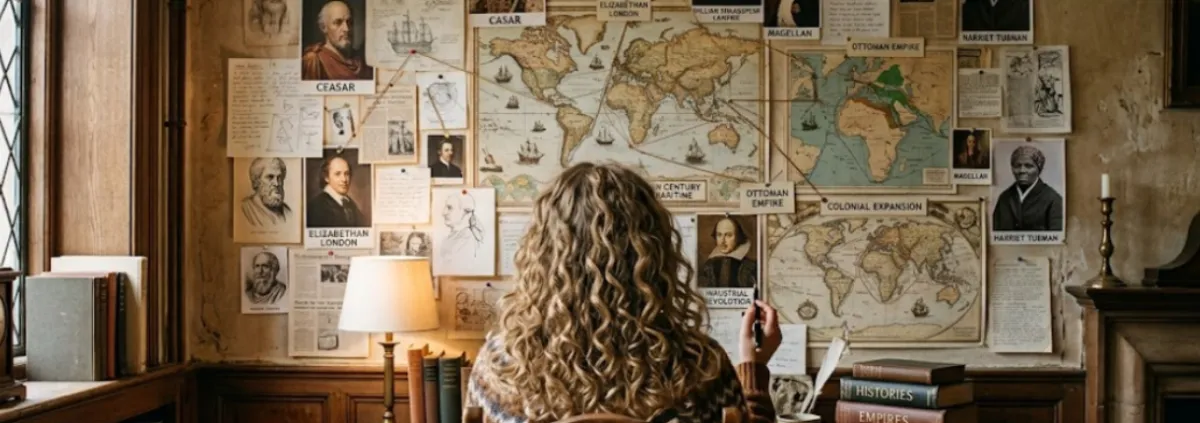
When I disappear into my writing world, the modern world fades. The hum of electricity dies, replaced by the rhythmic creak of ship timbers, the smell of coal smoke, and the bite of a cold Atlantic gale or the clanging of medieval swords.
To me, writing historical fiction is about delving into the past and creating rich historical worlds. I've written about the French Occupation during WW2, the medieval era during the time of the Spanish Inquisition, and I'm currently writing about the rigid, suffocating elegance of the Victorian 1870s and breaking down that stiff society segregation by dropping my characters into colonial Africa.
Here is why I am utterly obsessed with building these worlds.
Rich Historical Research
What I love most is the research. Not the dates and battles, but the small things: what people ate when there was nothing to eat, what they whispered to each other when they couldn't say things out loud, how their courage rose to thwart their challenges. That's where I find the authentic story.
In research.
It can be a gruelling process trawling through facts and archives, but there are so many historical facts that really bring stories to life.
When I started my Morganstar series (Outlander meets 1883 in colonial Africa), I knew my main character was going to get to the South African diamond rush, but how she got there became a season all of its own simply by injecting historical facts and weaving them into the different books.
What Inspires Me?
The Bridge of Lies, Mask of Secrets, and Dolls of Deceit trilogy came from wanting to know what the French Occupation actually did to the people living through it day to day, not just the history books' version of events. I love France and visit often, and each time I found a special setting, I was inspired to create a story about it.
As a reader, that's what pulls me into historical fiction too. I want to feel like I was there, not like I'm being given a lecture on the subject.
Nothing exposes human nature more quickly than breaking down their society rules. I am now enjoying taking characters raised on tea-parlour etiquette, pristine lace, and whispers among women, and dragging them onto a sun-bleached Namibian beach off the Skeleton Coast and into the lawless, mud-choked trenches of the Kimberley diamond rush.
It's so much fun!
Exploring Historical Senses
I want my readers to experience the settings for themselves, feel them, taste them, hear them, and touch them. I love exploring the settings through the senses of my characters, and of course, those senses shift from character to character, since I have a whole ensemble cast of fictional people to keep my readers engrossed in my series.
By grounding the story in the five senses—the pungent tang of coastal ports, the freezing weight of river water, a flash flood racing and tearing at sodden clothes, the eerie, cloying air of a Calima, the skeletal boats rotting along the shoreline like whalebones—the past stops being a crusty journal and becomes an adrenaline rush for my readers to binge.
In Morganstar, the landscape is a living, breathing character.
Dangerous History
The Victorian era is most often romanticised, but the truth was far dirtier, hungrier, and more thrilling. It was a time of massive migration, sudden fortunes, and deep moral compromises. That's the 'secret sauce' I am exploring in my series.
My favourite TV series are the ones where there is constant danger and the characters are facing life-or-death stakes. Shows such as Outlander, 1883, American Primeval and Hell on Wheels are riveting, and Ken and I binged them all. I'm trying to emulate that in my writing and allow my readers to experience the dangers that people faced in historical times.
Most of all, writing historical fiction allows me time away from modern life, where I can explore historical facts and spin yarns from them.
That is why I write. To find the raw, beating heart of humanity within a rich, historical world.


Thank you Brenda Mohammed