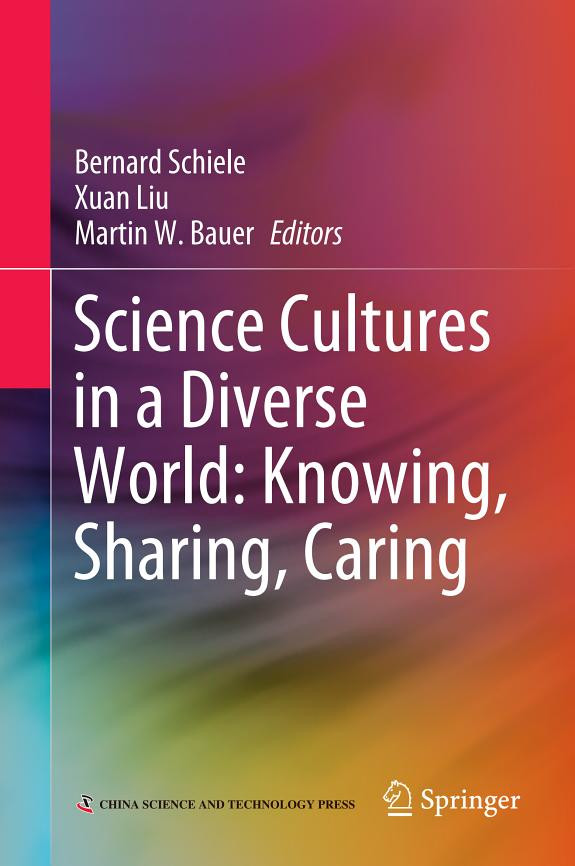
Science Cultures in a Diverse World: Knowing, Sharing, Caring
0 reviews
5
views
By Bernard Schiele, Xuan Liu, Martin W. Bauer (2021)
Science and technology culture is now more than ever at the very heart of the social project, and all countries, to varying degrees, participate in it: raising scientific literacy, improving the image of the sciences, involving the public in debates and encouraging the young to pursue careers in the sciences. Thus, the very destiny of any society is now entwined with its ability to develop a genuine science and technology culture, accessible for participation not only to the few who, by virtue of their training or trade, work in the science and technology fields, but to all, thereby creating occasions for society to debate and to foster a positive dialogue about the directions of change and future choices. This book organized on the theme of ‘knowing, sharing, caring: new insights for a diverse world’, which was derived from the observation that globalization rests upon diversity—diversity of contexts, publics, research, strategies and new innovating practices—and aims to stimulate exchanges, discussions and debates, to initiate a reflection conducive to decentring and to be an opportunity for enrichment by providing the reader with means to achieve the potentialities of that diversity through a comparison of the visions that underpin the attitudes of social actors, the challenges they perceive and the potential solutions they consider. Thus, this book aims first and foremost to raise questions in such a manner that readers so stimulated will feel compelled to contribute and will do so. In this spirit, however significant, the results presented and shared are less important than the questions they seek to answer: How are we to rethink the diffusion, the propagation and the sharing of scientific thought and knowledge in an ever more complex and diverse world? What to know? What to share? How do we do it when science is broken down across the whole spectrum of the world’s diversity? The book is recommended for those who are interested in science communication and science cultures in the new media era, in contemporary social dynamics, and in the evolution of the role of the state and of institutions. It is also an excellent reference for researchers engaging in science communication, public understanding of science, cultural studies, science and technology museum, science–society relationship and other fields of humanities and social sciences.





Reviews
Have you read this book?
Share a quick thought — even 1–2 sentences helps other readers.