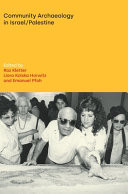
Community Archaeology in Israel/Palestine
0 reviews
3
views
By Raz Kletter, Liora Kolska Horwitz, Emanuel Pfoh (2024)
Although Community (or Public) Archaeology originated in western countries, it has now spread all over the world. It integrates the archaeological past with living peoples in new and unique ways. It is however, a rather loosely-defined field; to some it means an attitude and a theoretical concept, which is, or should be, valid for archaeology as a whole and for every archaeologist. For others it is a certain practice or sub-field of archaeology, which by now has its own experts - that is, community archaeologists. It is perhaps not surprising that in Israel/Palestine Community Archaeology touches heavily upon the present, perhaps more than upon the past. No archaeology in this region is 'neutral' and the living communities are part of the heated, on-going political, social and religious conflicts that have shaped the past, and are shaping this land for over more than a hundred years. The question is whether archaeology, including Community Archaeology, strive to neutrality? Can Community Archaeology free us from the hegemonic position of the archaeologies of nations and states? This is the first volume dedicated to Community Archaeology in Israel/Palestine. Chapters in the book challenge (in several ways, though not always explicitly) the traditional "Biblical Archaeology" approach to the archaeology of Israel/Palestine. They present their individual concepts and ideas about Community Archaeology in Israel/Palestine, bringing different questions and treating different case studies, and also reaching different though not unrelated conclusions. The volume gives a first, refreshing look of a new archaeology in an old land.




Reviews
Have you read this book?
Share a quick thought — even 1–2 sentences helps other readers.